





How To Buy Gift Cards with Monero? The Easiest Way to Spend XMR

Updated: Mar 24, 2026


Introduction
A lot of people end up in the same spot: they’ve got XMR sitting in a wallet, they like what Monero stands for, and they still want an easy path to everyday purchases. Gift cards often fill that gap. They turn digital assets into something familiar, like an online checkout balance or a prepaid code you can use right away. That can matter for e-commerce, especially if you want to buy practical items without changing how you shop.
If you’ve ever searched “buy gift cards with Monero”, or “cards to buy with Monero”, you’ve probably noticed a pattern. Many everyday brands are reachable through crypto gift-card services (including options like giftoff) that accept XMR, even if the brand itself never touches crypto. That makes Monero gift cards one of the more practical bridges between privacy-focused money and normal spending, with real global reach for users anywhere in the world.
What Is Monero
Monero is a privacy coin built for confidential transactions, with privacy as the default rather than an optional setting.
It uses multiple privacy technologies together, including ring signatures, stealth addresses, and Ring Confidential Transactions (RingCT), which are designed to hide the sender, recipient, and amount details on-chain.
That privacy-first design has helped XMR build a strong user community over time, especially among people who prefer not to broadcast their spending history to the public internet.
For day-to-day use, the key idea is simple: XMR aims to make payments less revealing by design, and not by extra add-ons. That is one of the reasons some users choose to buy gift card with Monero.
Monero is a cryptocurrency focused on keeping transactions confidential by default. Instead of publishing a transparent trail that anyone can read, Monero is built around mechanisms that obscure common tracking points on a public ledger, without revealing common tracking points on a public ledger.
RingCT is one of the parts tied to hiding transaction amounts, and it became a mandatory feature for Monero transactions after it was introduced.
Why Use Monero to Buy Gift Cards
For people who care about Monero privacy, purchasing gift cards with Monero is a straightforward match. Paying for a gift card using XMR can reduce the amount of personal data exposed during the payment step, compared with traditional payment methods that often involve KYC and connect identity, billing address, and transaction metadata in one place.
That’s the heart of “private gift card purchases” in practice: fewer parties get a clear view of what you funded, how much you spent, and where you spend it next. This can support both privacy and security, but it’s not the same thing as guaranteed anonymity.
Do not confuse, however, the essence of this article with a “buy Monero with gift card” notion, which is the opposite of what we’re talking about here.
There’s still a reality check worth keeping in mind. Monero is designed to obscure transaction details on-chain, yet “anonymous gift cards with XMR” is not a promise anyone can make in every situation, unlike Bitcoin comparisons people sometimes assume.
Local laws, merchant terms, and the redemption step can all affect privacy, especially if a gift card gets redeemed in an account tied to a real-world identity.
How Buying Gift Cards with Monero Works
The flow is usually simple. A typical purchase looks like this: get XMR, pick a gift-card service that takes XMR, select your gift card and value, pay from your Monero wallet, receive a code, then redeem it. This is how many people purchase gift cards in practice.
Here’s the skimmable version many users follow for “how to buy gift cards with XMR”:
- Acquire XMR and keep a little extra for network fees.
- Pick a gift-card platform that explicitly supports Monero payments.
- Select the brand, region, and card amount, then go to checkout.
- Send XMR to the address shown (or scan a QR code) and wait for confirmation; once the order is processed, your digital code will be delivered.
- Receive a digital code by email or inside your account, then redeem it.
This section is only the overview. The detailed “XMR to gift card steps” and the safety checks come a bit later, where the small details tend to matter more than people expect.
Where You Can Buy Gift Cards with Monero
There are a few common paths here. Some services specialize in crypto gift cards, and some sites act more like directories that point you to many options.
Before picking any provider, confirm two things: that Monero is supported right now, and that the brand you want is sold in your region.
Dedicated Crypto Gift-Card Stores
Dedicated crypto gift card platforms are the most direct route, since they usually let you pay in crypto and receive a digital code quickly, and many of them offer a wide selection of gift cards across a variety of brands. Coinsbee explicitly markets the option to buy gift cards with Monero (XMR).
Baxity has a page dedicated to buying gift cards with Monero, and it describes the standard flow of selecting a card, paying in XMR, then receiving a code via email after confirmation.
People often mention Bitrefill in this space, and it’s a real example of why verification matters. This platform describes gift card checkout with multiple cryptocurrencies, yet its listed supported coins include options like Bitcoin (BTC), Ethereum (ETH), USDT, Litecoin, and Dogecoin, with no Monero shown on that list, so no option to buy a Monero prepaid card.
So “platforms similar to Bitrefill” is a useful mental model for the shopping experience, but it’s smart to confirm XMR support before assuming it’s there.
Some checkouts also support different cryptocurrencies like USDC or dash, and may include options like Binance Pay, but you still have to confirm what’s actually enabled at checkout for your region.
What to look for on any XMR gift card store:
- Clear Monero payment support shown at checkout, not just in a blog post.
- Reputation signals: long-running domain, real reviews, consistent support contact info.
- Refund and dispute rules that are easy to find, since digital codes can be tricky.
- Regional filters for brands and card denominations, so you don’t buy something you can’t redeem. If the store offers country variants, use them early to find your favorite brands and narrow down the best gift cards to buy.
Directories and Aggregators
Directories help when you don’t want to check dozens of stores one by one.
Cryptwerk has a category page that lists gift card vendors accepting Monero, and it frames itself as a directory of stores where users can buy gift cards with XMR.
That same directory page lists examples of brands that may be reachable through listed vendors, including names like Amazon, Apple App Store, Google Play, and Xbox, and you may also find gift cards for a variety of everyday options like Starbucks, Spotify, Playstation, AirBnb, Roblox, Kroger, Taco Bell, and Free Fire, depending on the vendor.
A directory is not a guarantee, though. Treat it as a map: click through, confirm that the store still accepts XMR, then confirm the brand and country variant you need.
Step-by-Step Guide: From Getting XMR Crypto to Spending It on Gift Cards
This is the point where most mistakes happen: not from “hard crypto,” but from rushing. Take it one step at a time, and treat each step as its own small checklist item.
The steps below mirror what most people do in real life, from getting XMR to redeeming the final code.
Step 1: Get Monero (XMR)
A typical SimpleSwap purchase or swap flow is straightforward for intermediate users: pick the direction, enter the XMR wallet address where you want to receive funds, then complete the payment.
Here how it goes, in a little more detail:
- Open SimpleSwap and choose Crypto Exchange.

2. In You Send, pick your coin (for example, USDT). In You Get, select XMR.
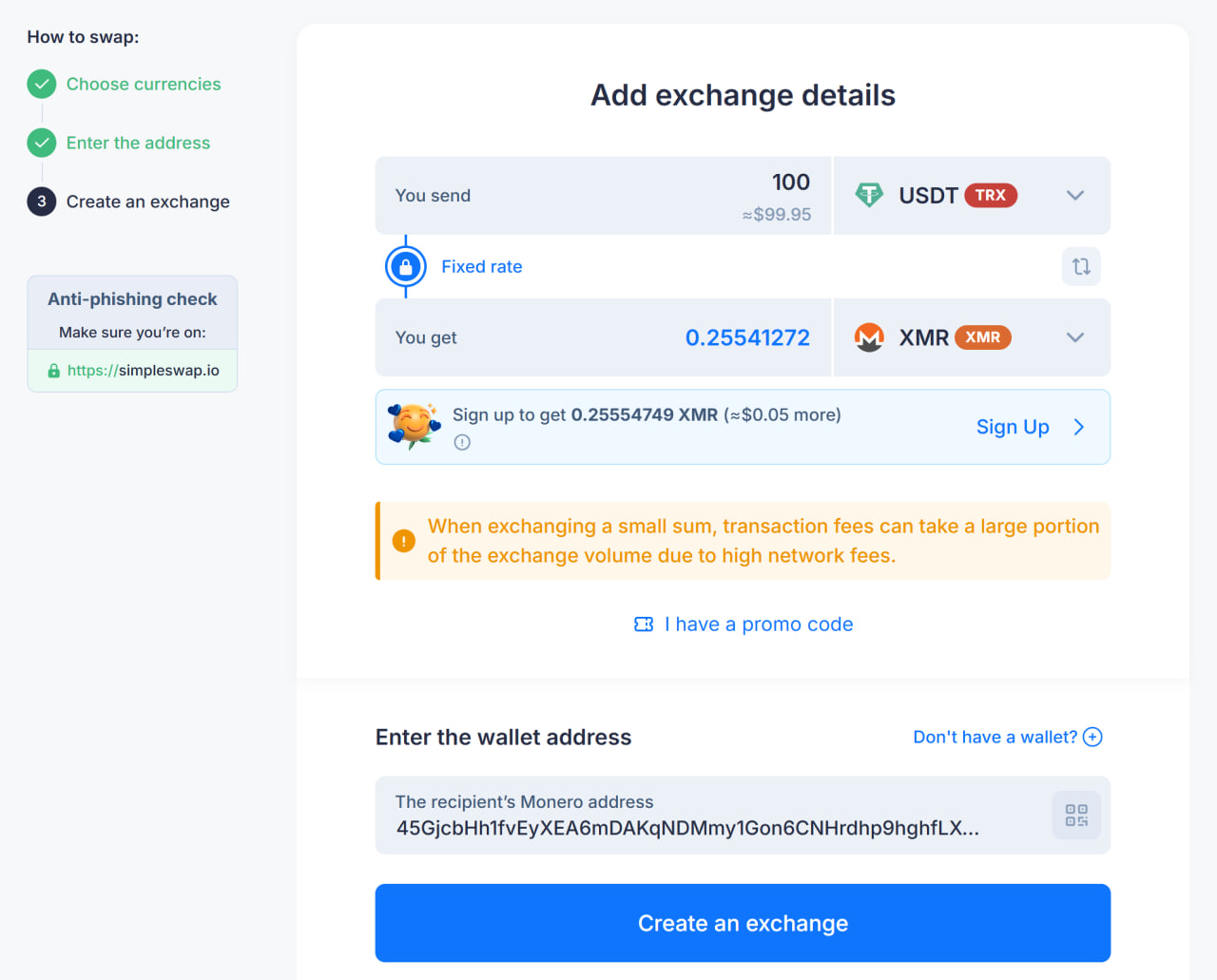
*The wallet address on the picture is provided for example purposes only, it is not a real one.
3. Click Exchange, paste your receiving address (so funds land where you’ll use them).
4. Confirm the rate and send your deposit.
5. Receive XMR (typically within minutes), no registration required.
Users can also use SimpleSwap to buy with crypto for fiat using debit or credit cards. On the coin pages it’s also possible to monitor the up-to-date prices and other key parameters.
Be sure to verify the ticker, chain, and the receiving address.
Two practical tips:
- Copy and paste the receiving address from your wallet, then re-check the first and last characters.
- Plan a little buffer so you are not left short on fees during the later “pay with XMR” step.
Step 2: Move XMR to a Secure Wallet
Before spending, many users prefer to hold XMR in a reputable non-custodial Monero wallet they control. Wallet choice varies across desktop and mobile, so the safer pattern is to focus on habits rather than brand names.
Good wallet hygiene usually looks like this:
- Back up the seed phrase offline, and store it somewhere you can access later.
- Set a strong password or device lock, and keep the device updated.
- Keep private keys and recovery phrases private, and avoid typing them into random websites.
Step 3: Choose a Gift-Card Platform That Accepts Monero
Picking a trusted XMR gift card site is less about fancy features and more about basic checks. Confirm Monero support, confirm the brand catalog, confirm regional coverage, and read the refund rules before paying.
A “typical platform” flow tends to look like this: browse the catalog, filter by country, pick the card amount, then proceed to checkout and select XMR as the payment option. Coinsbee and Baxity are examples of services that publicly present Monero gift card purchasing as a supported path.
If you use a directory like Cryptwerk to discover options, click through and verify the store’s checkout supports XMR before you commit.
Step 4: Pay with XMR and Receive the Gift Card
At checkout, the platform usually shows a Monero address (and often a QR code) plus an exact amount to send. Baxity describes this common pattern: the buyer is shown XMR transaction details, sends the funds, then receives a digital code after the payment confirms.
Delivery often shows up by email or in an account dashboard, and many services describe it as quick once confirmations are in.
Slow down at the most error-prone moment:
- Double-check the address character-by-character if you copied it across devices.
- Confirm the amount, and note that network fees exist, so having extra XMR helps.
- If it’s your first time with a new provider, a small test purchase can reduce stress.
Step 5: Redeem and Use the Gift Card
Redemption depends on the card type and the merchant. Common patterns include adding a code to an online retailer balance, applying it at checkout, or loading a prepaid or gift balance into an app for in-store use.
A few everyday examples people run into:
- An online retailer gift code gets applied to your account balance before checkout.
- A gaming code gets redeemed inside the console or game store.
Some prepaid cards get represented as a barcode or card number for in-store payment. Read the vendor’s redemption instructions and expiry rules first, since restrictions can vary by country variant and product line.
Fees, Limits, Regions, and Card Types to Know About
Gift cards feel simple, yet the fine print can change the final cost and whether a code is usable. Fees and availability are the main areas that surprise people.
Understanding Platform and Network Fees
The Monero network fee is part of sending XMR, and RingCT is part of how Monero hides amounts as a default feature, even though the fee itself is still a practical consideration during payment.
Network fees tend to be relatively low in many cases, yet they can vary depending on network conditions, so keeping a little extra XMR in the wallet helps avoid failed payments.
Then there’s the platform side. Gift-card services may include a markup, a service fee, or a spread in the exchange rate, so the “$100 card” may cost a bit more in crypto terms (or USD terms) depending on the provider and region.
Regional Availability and Supported Brands
Many services carry global brands across categories like retail, gaming, streaming, and travel, yet availability changes by country and even by brand variant. Cryptwerk’s Monero gift card directory page lists examples of brands that may be reachable via XMR-accepting stores, including Amazon, Apple App Store, Google Play, and Xbox.
Filters and country selection on the platform matter. Set your country first, then browse, rather than picking a brand and discovering it’s sold only in a different region.
Types of Cards to Buy with Monero
Most XMR gift card stores group products into familiar buckets:
- Retail and marketplaces: examples often include Amazon-style marketplace cards and apparel brands, depending on region.
- Gaming and credits: console store codes and game platform top-ups are common, including credits for gaming platforms.
- Subscriptions and digital services: app-store codes and video streaming-related cards show up on many catalogs.
- Travel and food delivery: some directories list travel booking and rideshare options, depending on the vendor list, and you may also see prepaid options like visa in some catalogs.
These examples are illustrative. The actual catalog depends on the platform, local rules, and inventory.
Staying Safe and Private When Buying Gift Cards with Monero
Buying gift cards with XMR safely is mostly about slowing down and checking the obvious things. Scams thrive on speed, and gift cards are a favorite target since codes can be resold fast.
Start with provider vetting. Look for a real reputation trail, clear support contact, and transparent terms. If a “deal” shows up via unsolicited DMs or a random Telegram message, it’s safer to assume it’s a trap and move on.
Then handle payment safety like a routine. Verify the domain and URL, and avoid clicking checkout links from ads you didn’t mean to open. Confirm the Monero address and amount carefully, and for a brand-new provider, a small test transaction can be a calm way to validate the flow.
Wallet hygiene matters just as much. Use a reputable non-custodial wallet, protect the seed phrase, keep devices updated, and treat clipboard tools and browser extensions with suspicion. Privacy hygiene goes past XMR too: minimize account data on gift-card sites, and think about where you redeem the code, since redemption can re-link identity through merchant accounts.
Monero improves transactional privacy by design, yet laws and merchant terms still apply, and practical privacy depends on user behavior across the full purchase and redemption chain.
Checklist for fast scanning:
DO:
- Confirm the store supports XMR at checkout, not only in marketing text.
- Verify the exact domain, and avoid lookalike URLs.
- Double-check the receiving address and payment amount before sending.
- Keep extra XMR for network fees and small pricing shifts.
DON’T:
- Buy codes from unsolicited DMs or “too good” offers.
- Redeem a privacy-motivated purchase inside a heavily identified account without thinking it through.
- Share seed phrases, screenshots of keys, or wallet backups with anyone.
Using Gift Cards for a Variety of Purposes
Gift cards can turn XMR into something you can actually use without waiting for direct merchant adoption. Below are a few ways people use Monero gift cards in daily life.
Everyday Shopping and Essentials
For everyday spending, the pattern is simple: use XMR to buy a gift card, then use that card for household purchases. That might mean topping up an online retailer balance for recurring essentials, grabbing household items, or sending a gift card to a family member and funding it with XMR on your side.
Digital Services, Gaming, and Subscriptions (Google Play, Roblox, Playstation, Xbox, Spotify, etc.)
Digital goods fit gift cards well: codes redeem cleanly, and delivery is usually fast. Many people use Monero-funded cards for game credits, app store balances, streaming subscriptions, and other online services where they prefer prepaid-style payments. This can be appealing for privacy-minded users, especially for services where they don’t want a long trail of card charges linked to a personal profile.
Gifting and Budgeting with XMR
Gift cards funded with XMR can work as presents, since the recipient gets something familiar without needing to handle crypto directly. It can work for budgeting too: set a fixed card amount for a month’s discretionary spend, then stop once it’s used.
Round-Up
Buying gift cards with Monero is a practical way to turn XMR into everyday spending without waiting for direct merchant adoption to catch up. Monero was built so transaction privacy is the default, which is part of why some users prefer it for payments tied to digital codes and prepaid balances. Gift cards can act like a bridge: XMR funds the purchase, then the gift card code becomes the thing used at checkout, in an app, or in an account balance.
The smoothest experience usually comes from treating this as a short routine. Start by confirming the store truly accepts XMR right now, then check the brand’s country variant and redemption rules before paying.
Keep an eye on two cost layers: the Monero network fee for sending XMR, and the gift-card provider’s own pricing, which may include a markup or service fee. It helps to keep a small extra buffer of XMR in the wallet so a purchase does not fail at the last moment.
The privacy piece does not end at payment. If the code gets redeemed inside a tightly identified merchant account, that step can connect the purchase to a profile even if the on-chain payment is private. So the “right” approach depends on the reader’s goal: convenience, privacy hygiene, or a mix of both. Either way, the safety rules stay steady: use a non-custodial wallet, protect recovery words like cash, verify URLs, and avoid offers that arrive through unsolicited messages.
For intermediate crypto users, the main benefit is flexibility. A single XMR balance can be converted into many categories of spending through gift cards, from shopping to digital services, and it can work for gifting or budget boundaries too.
Done with a little care, Monero gift cards are less about chasing anything and more about making XMR usable in normal life, even when brands aren’t directly brands using crypto rails or when you’re otherwise using cryptocurrency in a way merchants don’t natively support.
FAQ
What Is Monero?
Monero is a privacy-focused cryptocurrency where transaction privacy is the default setting. It uses three core privacy technologies: ring signatures, stealth addresses, and Ring Confidential Transactions (RingCT), which are meant to hide the sender, receiver, and amount details respectively. Monero’s own FAQ stresses that all transactions on the network are private “by mandate,” so there’s no “transparent transaction” mode to accidentally use.What makes it different in everyday use:
- Private by default across the network.
- Sender, receiver, and amount are obscured using different mechanisms.
- Users can share a view key if they want someone else to see incoming payments and balances.
Why Use Monero to Purchase Gift Cards?
Using Monero for gift cards is mostly about practicality and payment privacy. Monero is designed to hide transaction details on-chain, which can appeal to people who prefer not to expose their spending trail to the public. Gift cards add convenience, since they can be redeemed across everyday categories like retail, app stores, gaming, subscriptions, and travel-style services, depending on region and inventory.A second reason is flexibility: a single XMR balance can be converted into different brand codes without needing each brand to accept crypto directly. Platforms like Coinsbee explicitly position Monero (XMR) as a payment option for gift cards, which reflects how common this route has become.
Is Monero Safe to Use for Digital Purchases?
It helps to separate protocol safety from user safety. Monero’s protocol is designed around private transactions by default, using ring signatures, stealth addresses, and RingCT to hide key transaction details. That said, user safety depends on everyday actions: keeping seed phrases private, using a reputable non-custodial wallet, and avoiding suspicious “deal” links or clone websites.
Digital gift cards add a specific risk: once a code is issued, it can be hard to reverse if something goes wrong, so provider trust and careful checkout habits matter. Monero can improve transactional privacy, but it can’t protect someone who sends funds to the wrong address or redeems a code in a highly identified merchant account.
How Do Transaction Fees Work on Monero?
Fees usually come from two places. First is the Monero network fee, which is part of sending XMR from a wallet to a merchant address. RingCT is the mechanism used to hide Monero transaction amounts, and Monero’s documentation notes it became mandatory for all transactions after September 2017. That privacy design doesn’t remove fees, so it’s still smart to keep a bit of extra XMR available for the send.Second is the service layer: gift-card platforms can price cards with a markup, a service fee, or an exchange-rate spread. The final cost can vary by provider, card type, and region, so comparing totals at checkout is often more useful than comparing headline “card value.”
Is Monero Traceable?
Monero is designed to make tracing harder by obscuring transaction details on-chain through ring signatures, stealth addresses, and RingCT. Monero’s FAQ describes these technologies as hiding the sender, receiver, and amount, and it emphasizes that private transactions are mandatory across the network. In plain terms, XMR aims to avoid the “public transaction graph” problem common on transparent blockchains.
Practical caveat: privacy does not stop at the blockchain. The gift-card store can still log order metadata, and the merchant where the code gets redeemed may connect redemption to an account profile, device data, or other identifiers. Monero improves transactional privacy, yet the full privacy outcome depends on broader hygiene.
What Gift Card Brands Can I Buy With Monero?
Brand availability depends on the gift-card platform and the country or region selected. Cryptwerk maintains a directory page for gift-card vendors accepting Monero, and it lists examples of brands that may be available through those vendors, such as Amazon, Apple App Store, Google Play, Uber, Uber Eats, and Xbox. Availability can still change based on regional catalogs, inventory, and local restrictions, so it’s normal to see a brand offered in one country but not another.
The practical approach is to use the platform’s country filters first, then check the exact brand variant and redemption rules before paying. A directory is useful for discovery, yet checkout verification matters more than the listing itself.
The information in this article is not a piece of financial advice or any other advice of any kind. The reader should be aware of the risks involved in trading cryptocurrencies and make their own informed decisions. SimpleSwap is not responsible for any losses incurred due to such risks. For details, please see our Terms of Service.


